Martyn’s Law for UK venue: Understanding the Terrorism (Protection of Premises) Act 2025, who is responsible and how integrated technology may support public safety. This guide explores Martyn’s Law requirements, including the standard and enhanced tiers, public protection procedures and how organisations can prepare.
Public safety is an important consideration in the design, operation and management of facilities that welcome members of the public.
From health and fitness clubs and leisure centres to hotels, retail environments and entertainment venues, organisations operate spaces where people gather every day.
The introduction of Martyn’s Law represents an important development in the UK’s approach to preparedness for terrorist attacks.
With the legislation expected to come into force in spring 2027, organisations operating publicly accessible premises should understand whether it applies to them and what their responsibilities may be.
But what exactly does Martyn’s Law require, who is responsible, and where can technology play a supporting role?.
What is Martyn’s Law?
Martyn’s Law, officially the Terrorism (Protection of Premises) Act 2025, is UK legislation intended to improve public safety by strengthening preparedness and protective security at certain premises and events.
It is named in memory of Martyn Hett, one of the 22 people killed in the Manchester Arena terrorist attack in May 2017.
Martyn’s mother, Figen Murray OBE, campaigned for the introduction of the legislation, which received Royal Assent on 3 April 2025.
The Act introduces requirements for those responsible for qualifying premises and events to prepare for potential terrorist attacks and reduce the risk of physical harm.
Certain larger premises and events will have additional responsibilities relating to protective security.
The Security Industry Authority (SIA) will regulate compliance.
Although the Act is expected to come into force in spring 2027, the exact commencement date has yet to be confirmed. There is no requirement to comply with the substantive duties until they come into force.
Who does Martyn’s Law apply to?
The legislation applies to qualifying premises and events that meet specific legal criteria.
For premises, the Act considers four main factors:
- Whether the site meets the legal definition of premises.
- Whether it is wholly or mainly used for a purpose specified in the legislation.
- Whether 200 or more people, including staff, can reasonably be expected to be present simultaneously, from time to time.
- Whether any statutory exclusions apply.
Specified uses include sports and leisure activities, entertainment, hospitality, retail and certain education and healthcare settings.
However, not every facility within these sectors automatically falls within scope.
For example, a fitness facility must be considered against the qualifying criteria rather than assuming that all gyms are covered.
Qualifying events are assessed separately. The criteria include public accessibility, specified entry checks, an expectation of at least 800 people present simultaneously and other statutory conditions.
The Home Office statutory guidance provides detailed information on determining whether particular premises or events qualify.
Who is the Responsible Person?
One of the most important questions for organisations is who holds responsibility under the legislation.
The Act identifies the Responsible Person as the individual, company or organisation that has control of qualifying premises for their relevant use, or control of the premises for the purposes of a qualifying event.
This means the Responsible Person is not necessarily the building owner.
For example, where a company leases and operates qualifying premises, that company may be the Responsible Person rather than the landlord.
The Responsible Person may delegate individual tasks to staff or external providers, but cannot delegate overall legal responsibility under the Act.
What about larger organisations?
For enhanced-tier premises and qualifying events, where the Responsible Person is a company or organisation rather than an individual, a sufficiently senior individual must be designated to ensure that the organisation complies with its requirements.
This person must have an appropriate level of authority within the organisation. The Home Office guidance also recognises that a company operating several qualifying premises may be the Responsible Person for multiple locations. However, its procedures and measures must reflect the individual circumstances of each site.
What happens in shared buildings?
Where qualifying premises form part of other qualifying premises, responsible parties may be required to co-ordinate arrangements, so far as reasonably practicable.
Additional duties to co-operate can apply to individuals or organisations with some degree of control over enhanced-tier premises or qualifying events, even where they are not the Responsible Person.
For organisations operating within shared buildings or multi-occupancy developments, understanding these distinctions is particularly important.
The Home Office has published a dedicated infographic explaining the Responsible Person and the relevant legal definitions.
Understanding the standard and enhanced tiers
Martyn’s Law introduces a proportionate approach, with different requirements depending on the nature and size of qualifying premises.
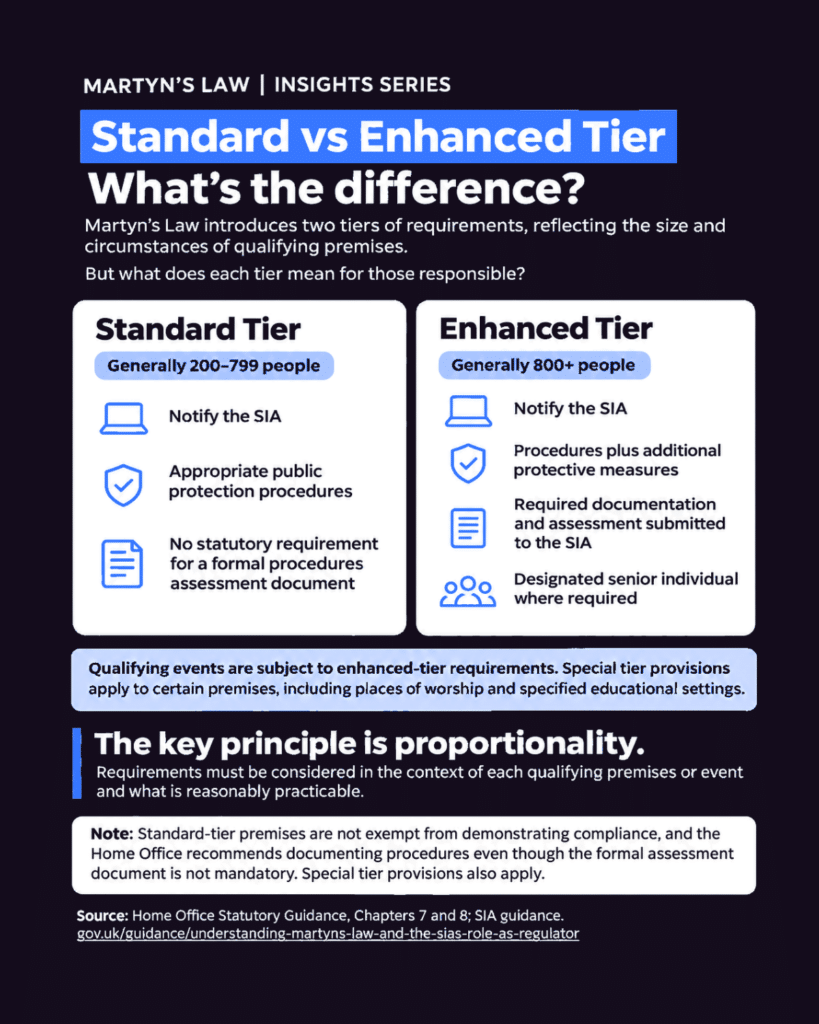
Standard Tier
For most qualifying premises, the standard tier applies where between 200 and 799 people can reasonably be expected to be present simultaneously.
Those responsible must notify the SIA in accordance with the relevant requirements once the legislation comes into force.
They must also have appropriate public protection procedures in place, so far as reasonably practicable.
The focus is on preparing to respond effectively and reducing the risk of physical harm if an attack occurs.
Enhanced Tier
For most qualifying premises, enhanced-tier requirements apply where 800 or more people can reasonably be expected to be present simultaneously.
Qualifying events are also subject to enhanced-tier requirements.
In addition to the standard-tier duties, those responsible must put appropriate public protection measures in place, so far as reasonably practicable.
These measures address four areas:
- Monitoring: Monitoring premises, events and their immediate vicinity.
- Movement: Managing the movement of people into, out of and within premises or events.
- Physical safety and security: Measures intended to reduce vulnerability and potential harm.
- Security of information: Protecting information about premises that could otherwise assist the planning of an attack.
Enhanced-tier requirements also include documenting procedures and measures, assessing their effectiveness, submitting the required information to the SIA and designating a senior individual where applicable.
Special tier provisions apply to certain premises, including places of worship and specified educational settings.
The four public protection procedures
A central element of Martyn’s Law is the requirement to consider appropriate public protection procedures.
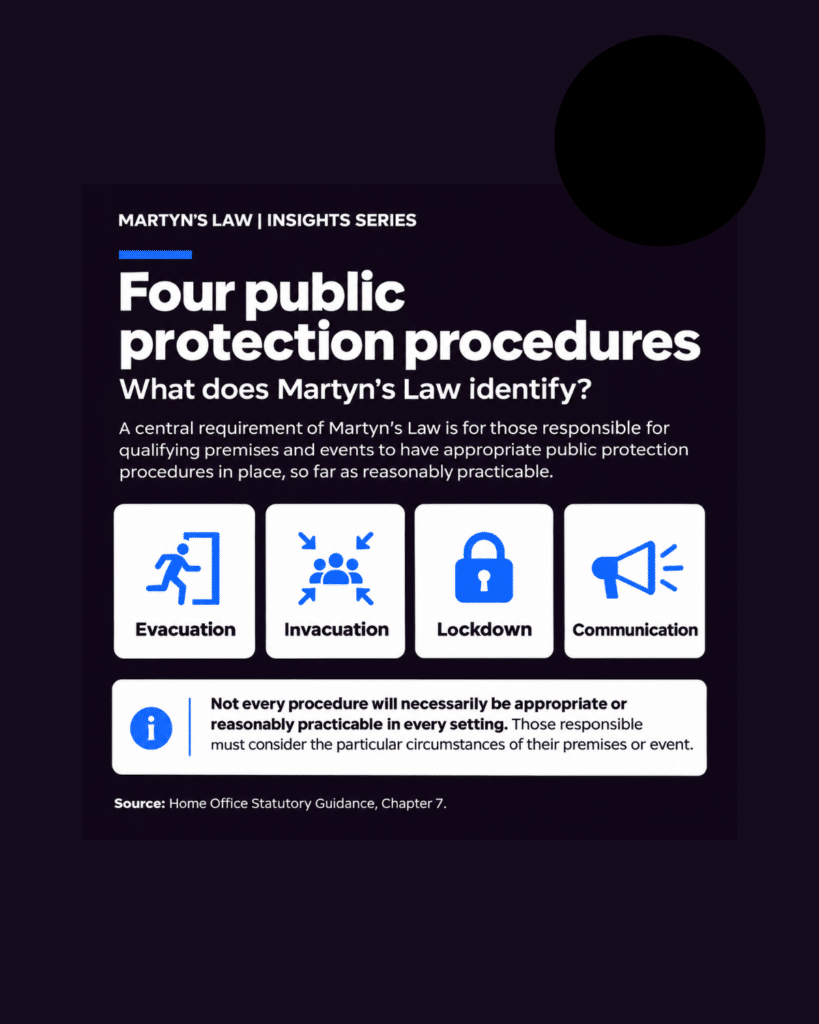
The Act identifies four types.
- Evacuation: Moving people away from danger by leaving the premises, event or affected area.
- Invacuation: Moving people to a location within the premises or event where there is less risk of physical harm.
- Lockdown: Securing premises or an event to prevent individuals entering or leaving.
- Communication: Ensuring information is provided to individuals at the premises or event.
These procedures must be considered in the context of the particular premises or event.
Not every procedure will necessarily be appropriate or reasonably practicable in every setting.
Importantly, effective preparedness also depends on the people responsible for implementing the procedures.
Relevant staff must understand their responsibilities and receive the necessary information and instruction.
Although the Act does not require organisations to purchase particular training courses, it is important that the relevant procedures can be implemented effectively.
Does Martyn’s Law require new security technology?
One of the most important distinctions for venue operators is that Martyn’s Law does not automatically require the purchase of specific security equipment.
The Home Office statutory guidance confirms that there is no universal requirement to make physical alterations or purchase specific equipment simply to put public protection procedures in place.
However, it also recognises that equipment or physical alterations may be appropriate and reasonably practicable in particular circumstances.
For enhanced-tier premises and qualifying events, additional public protection measures may include physical technology, depending on the requirements identified.
Organisations should therefore understand their responsibilities before making decisions about technology investment.
How can integrated technology support public safety?
Many facilities already operate a range of technologies, from audio and public address systems to access control, visual displays and networked infrastructure.
Where appropriate, these systems may support public protection procedures and wider operational requirements.
Audio and public address
Communication is one of the four public protection procedures identified under Martyn’s Law. The Home Office guidance recognises public address systems as one possible method of communicating emergency instructions, particularly at larger premises and events.

For facilities with multiple activity areas, understanding whether information can reach people effectively may be an important technical consideration.
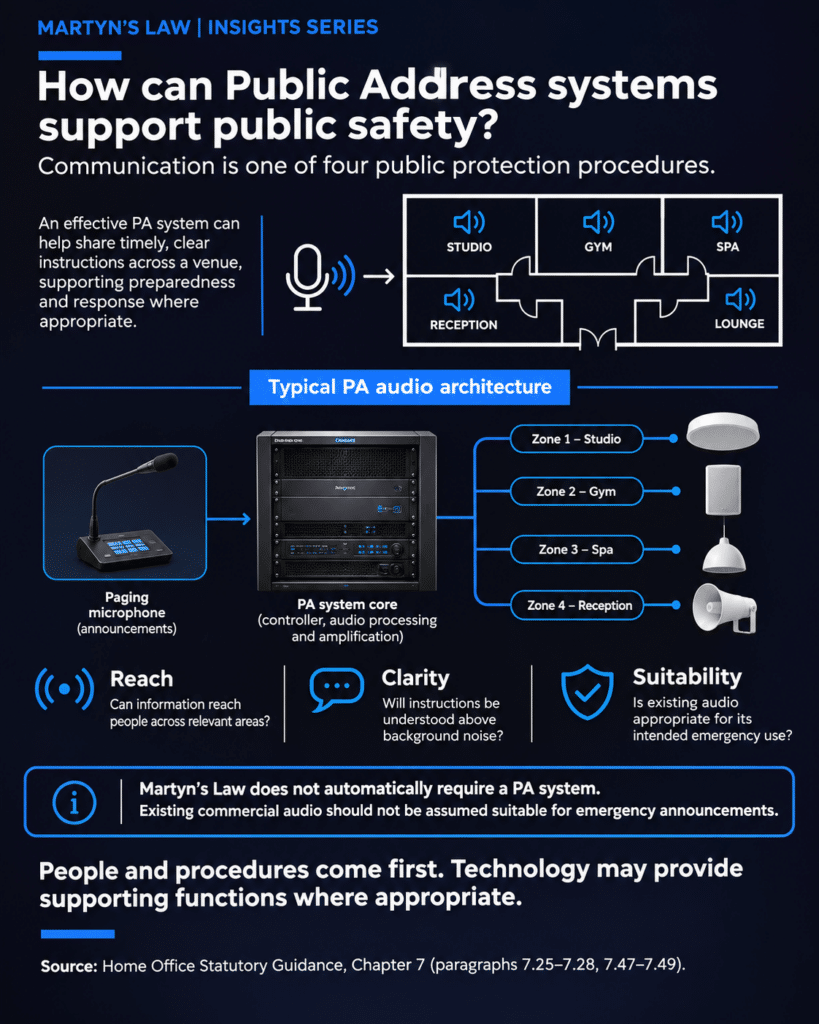
Existing commercial audio systems should not automatically be assumed suitable for emergency announcements. Their capabilities and suitability must be established.
Access control
Access control arrangements are also discussed within the statutory guidance, particularly in relation to enhanced-tier measures concerning the movement of people.
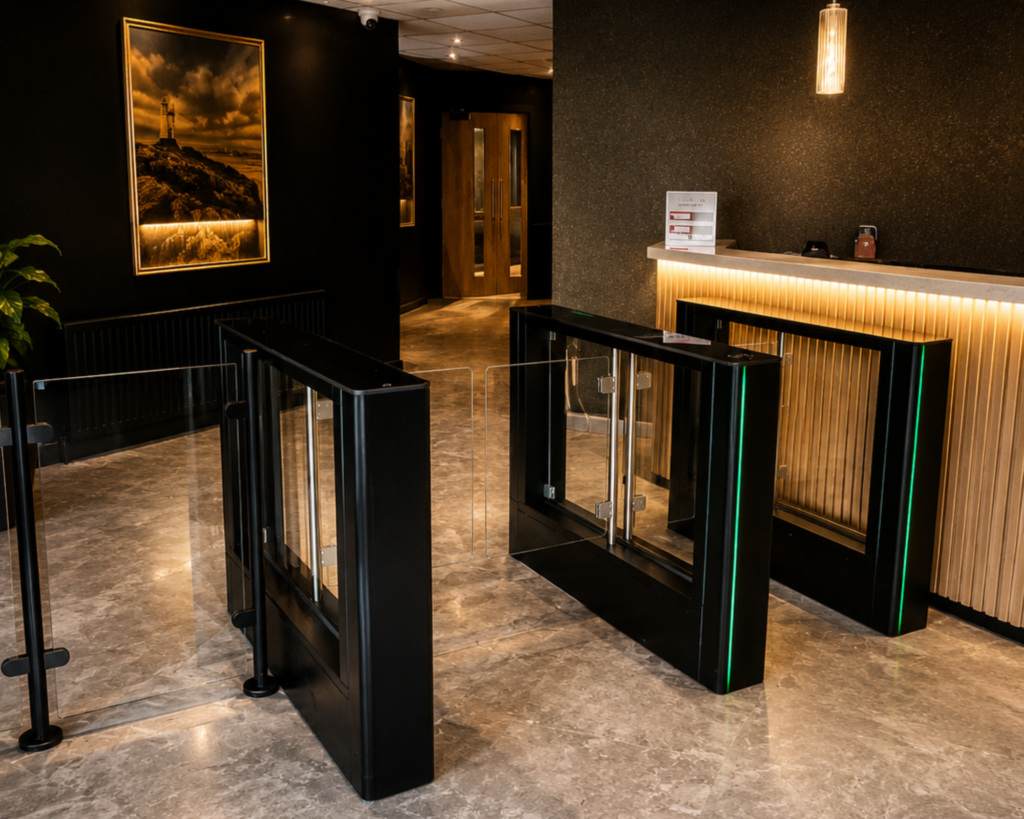
Appropriate systems may help manage access to specific areas and support relevant operational procedures.
Any proposed integration must take account of other applicable requirements, including safe means of escape.
Security lighting and monitoring
The guidance identifies security lighting as one example of a potential monitoring measure for enhanced-tier premises and qualifying events.
It also discusses CCTV and other possible monitoring approaches.
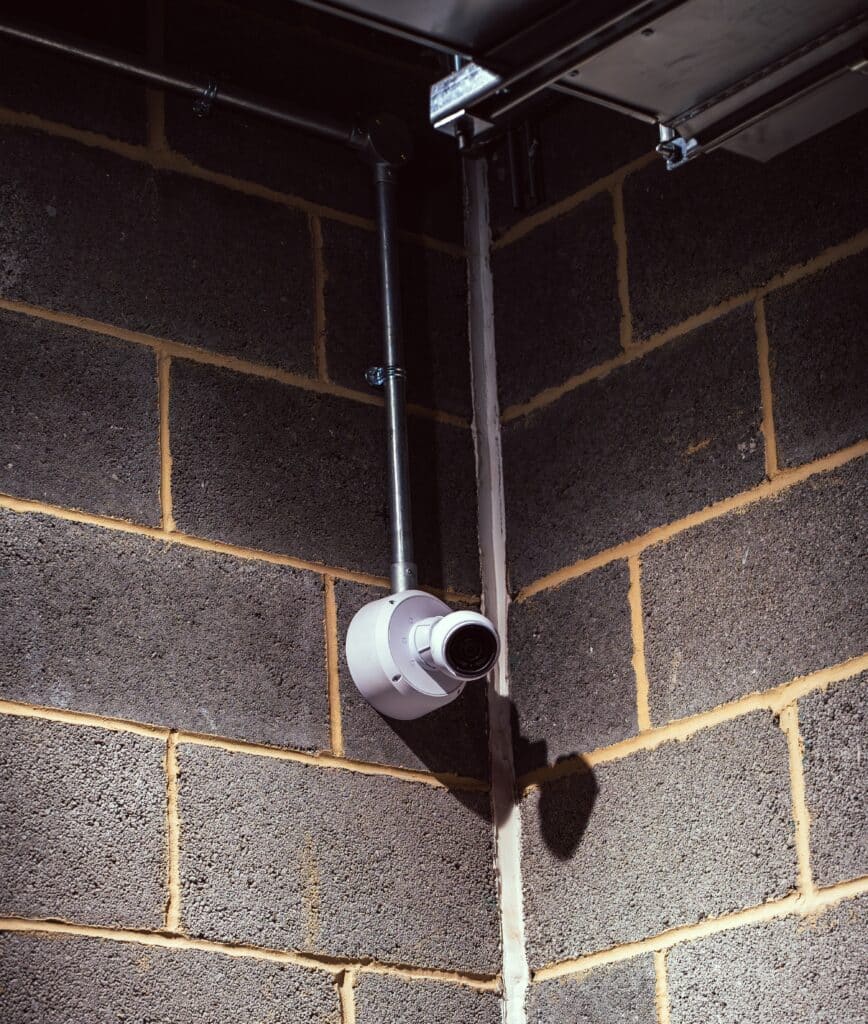
These are examples for consideration rather than universal equipment requirements.
Security lighting serves a different primary purpose from architectural or decorative feature lighting.
Connected building systems
Beyond the technologies specifically discussed in the guidance, other integrated systems may provide supporting functions.
For example, visual displays could offer an additional communication channel, while networking and automation may help connect appropriate communication and security infrastructure.
These are potential technical applications, not statutory technology requirements.
Their suitability depends on the operational needs of the facility and any identified requirements.
Why integration expertise matters
As facilities become increasingly connected, understanding how different systems operate together can be an important part of technical planning.
Consider a leisure facility with several studios, communal spaces, independent audio systems, access control and centralised building infrastructure.
Where a need for improvements has been identified, a coordinated approach can help ensure that individual components are appropriate for their intended purpose and operate effectively together.
At Hutchi, our expertise is in designing technology around the needs of the people using and managing a space.
At Hutchi, we design and integrate technology for immersive spaces and next-generation concepts across developments and refurbishments. Our technologies include audio, visual, feature lighting, automation, networking and access control. We support our Customers with anything from a single studio or dedicated space through to entire facilities and multi-site roll-outs.
Our approach combines three core strengths:
- Integration Expertise: Seamlessly integrating audio, visual, lighting, automation, networking and access control technologies to meet the specific requirements of each project.
- Bespoke Solutions: Developing tailored designs through our in-house technical team.
- Comprehensive Support: Providing dedicated service and maintenance coverage across the UK and EU.
WWhere Customers identify a need for appropriate technology improvements, Hutchi can support the relevant design, integration, commissioning and ongoing maintenance
Determining legal compliance remains the responsibility of the relevant person or organisation under the Act.
Preparing for Martyn’s Law: Where should organisations start?
The Home Office and SIA encourage organisations that may fall within scope to familiarise themselves with the legislation before it comes into force.
A practical starting point includes:
- Establish whether the legislation applies: Review the official criteria for qualifying premises and events.
- Identify the Responsible Person: Understand who holds legal responsibility and whether a designated senior individual will be required.
- Understand the applicable tier: Consider whether standard or enhanced-tier requirements apply, including any special provisions.
- Review public protection procedures: Consider what is appropriate and reasonably practicable for evacuation, invacuation, lockdown and communication.
- Ensure relevant staff understand their roles: Consider the knowledge, information and instruction needed to implement the relevant procedures and measures.
- Consider existing infrastructure: Where relevant, understand whether existing technologies can support identified operational requirements and whether improvements may be beneficial.
This technology review is a practical recommendation, not a separate statutory duty under Martyn’s Law.
Supporting safer, more connected spaces
Martyn’s Law represents an important step towards improving public safety and preparedness at qualifying premises and events across the UK.
For organisations, the priority should be to understand the requirements, establish responsibilities and consider what arrangements are appropriate for their particular environment.
Technology can play a supporting role, but it should always be considered as part of the wider operational and public protection arrangements.
At Hutchi, we’re committed to designing and integrating technology made for people.
If you’re reviewing your facility’s technology infrastructure and would like to discuss appropriate audio, visual, access control, networking or automation solutions, we’d welcome the opportunity to explore your requirements.
Reviewing your venue’s technology infrastructure?
Whether you’re assessing existing systems or considering improvements to audio, public address, access control, networking or automation, Hutchi can help you explore solutions tailored to your facility’s operational needs.
Complete the form below to discuss your requirements with our team.
W: https://hutchi.tech/contact
P: +44 (0)333 2407369
Technology made for people.
Official sources and further reading
This article is intended to raise awareness and provide general information. It does not constitute legal advice or a formal assessment of compliance with Martyn’s Law. Technical applications discussed are illustrative and should not be interpreted as mandatory equipment requirements.
- ProtectUK — Martyn’s Law https://www.protectuk.police.uk/martyns-law
- Home Office — Terrorism (Protection of Premises) Act 2025: Statutory Guidance https://www.gov.uk/government/publications/the-terrorism-protection-of-premises-act-2025/terrorism-protection-of-premises-act-2025-statutory-guidance
- Security Industry Authority — Understanding Martyn’s Law and the SIA’s Role as Regulator https://www.gov.uk/guidance/understanding-martyns-law-and-the-sias-role-as-regulator
- Home Office — Responsible Person infographic https://www.protectuk.police.uk/sites/default/files/2026-04/Responsible%20Person.pdf
- Schedule 1 — Specified Uses of Premises: https://www.legislation.gov.uk/ukpga/2025/10/schedule/1
- Section 4 — Persons Responsible for Qualifying Premises or Events: https://www.legislation.gov.uk/ukpga/2025/10/section/4
- Home Office — Principal Use of Premises Guidance (September 2026): https://www.gov.uk/government/publications/terrorism-protection-of-premises-act-principal-use-of-premises/terrorism-protection-of-premises-act-principal-use-of-premises-accessible